Estimate how posture changes the load on your neck.
· By Pelion Posture· Last updated
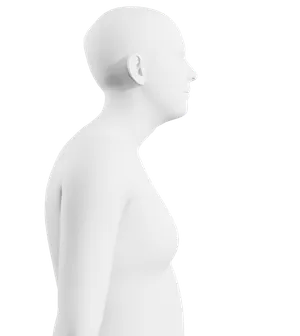
Tilting your head forward increases the load your neck muscles carry. A widely cited 2014 model estimates roughly 5 kg at neutral rising to about 27 kg at 60° of tilt. Pelion applies that curve to how far you lean from your own calibrated upright — an estimate, never a measurement of your body.
Try it — no camera needed
Drag the slider to change the tilt angle and watch the estimate move. Nothing here asks for your camera and nothing is sent anywhere.
The reference points
These are the five published values Pelion interpolates between. Any angle in the slider above is a straight line drawn between the two nearest rows.
| Forward tilt | Estimated load | In context |
|---|---|---|
| 0° | 5.4 kg · 12 lb | Neutral — your head balanced over your shoulders |
| 15° | 12 kg · 26 lb | About 2.2× the neutral figure |
| 30° | 18 kg · 40 lb | About 3.3× the neutral figure |
| 45° | 22 kg · 49 lb | About 4.1× the neutral figure |
| 60° | 27 kg · 60 lb | About 5.0× the neutral figure |
What the number is measuring
The curve above is about angle, not about you. What Pelion adds is the reference point: during a ten-second calibration you sit the way you actually want to sit, and that becomes 0°. Everything afterwards is how far you have moved from that, read off the curve.
So the number is not “how much your head weighs” and not “how much load your spine is under right now”. It is: at the angle you are currently holding, this is roughly what the model says a neck carries. Two people at the same measured angle see the same figure, because the model has no idea how big either of them is.
The product-method walkthrough shows where that estimate sits between the camera-derived angle, visible feedback and the optional local MCP boundary.
Where the numbers come from
They come from Hansraj (2014), a short paper in Surgical Technology International that modelled the forces on the cervical spine as the head tilts forward. Its figures — roughly 12 lb at neutral rising to 60 lb at 60° — are the ones repeated in almost every “text neck” article you have seen.
Pelion converts those to kilograms and interpolates linearly between them. Linear interpolation is a simplification: the real relationship is not a straight line between the published points, and no finer-grained published data exists to improve on it.
The limitations, stated plainly
- It is a model, not a measurement. Hansraj computed these forces; nobody put a sensor on a spine to read them. The publicly available abstract does not contain the figures at all — they come from the full paper.
- It is one short paper by one author, published in 2014 in a surgical technology journal. It is widely cited in popular coverage, which is not the same as being widely replicated.
- It describes static positions. Holding a posture for a second and holding it for an hour are very different for your body, and a single-instant figure says nothing about that difference.
- It does not know you. Height, head size, muscle, age and prior injury all matter, and none is an input.
- Pelion measures angle from a webcam, which has its own error. When the model is unsure, the app shows nothing rather than guessing.
Posture and pain are not the same question
It is tempting to read a rising number as “this is damaging me”. That is further than the evidence supports, and the published reviews do not fully agree with each other.
A 2019 systematic review and meta-analysis found that adults with neck pain do show more forward head posture than people without it, and that the two correlate in adults and older adults — but found no such association in adolescents, and rated the overall certainty of the evidence very low, with age acting as a confounder. A 2023 systematic narrative review reached a firmer conclusion, stating that a significant relationship exists and that forward head posture increases the risk of neck pain.
Both are cited below so you can read them yourself. What neither establishes is causation in your particular neck: an association between two things measured in a population does not tell you that one produced the other, or that changing one will change the other for you.
What a load estimate is good for is noticing — seeing that you have been leaning in for forty minutes without registering it, and moving. That is a useful feedback loop. It is not a diagnosis, a prognosis, or a reason to be alarmed by a number going up.
When to stop reading web pages and see someone. The NHS advises seeing a GP if neck pain or stiffness does not go away after a few weeks, if painkillers such as paracetamol or ibuprofen have not worked, if you are worried about the pain, or if you have other symptoms “like pins and needles or a cold arm”, which it notes “could be something more serious”. None of that is something an app can assess.
Sources
The angle-to-load figures come from Hansraj (2014); its PubMed abstract states the study's purpose but does not reproduce the numeric results. The two reviews are cited because they reach different conclusions about how strong the posture–pain association is. The red-flag guidance is the NHS's, not ours.
- Hansraj KK. Assessment of stresses in the cervical spine caused by posture and position of the head. Surg Technol Int. 2014;25:277–279. PMID 25393825 — Surgical Technology International (via PubMed). Checked
- The Relationship Between Forward Head Posture and Neck Pain: a Systematic Review and Meta-Analysis. PMID 31773477 — PubMed. Checked
- Yang S, Boudier-Revéret M, Yi YG, Hong KY, Chang MC. Treatment of Chronic Neck Pain in Patients with Forward Head Posture: A Systematic Narrative Review. Healthcare (Basel). 2023. PMC10572307 — Healthcare (Basel), via PubMed Central. Checked
- Neck pain — when to see a GP (last reviewed 27 April 2023) — NHS. Checked
The same model, in other languages
These are written separately for each market rather than translated, so they cover different ground — but all four explain the same angle-to-load estimate this page describes.
- デスクワークの姿勢改善 — 何がわかっていて、何がわかっていないか日本語
- 거북목이란? 근거로 확인하는 것과 책상에서 바꿀 수 있는 것한국어
- 烏龜頸是什麼?證據、工作習慣,還有什麼時候該求助繁體中文
- Como corrigir a postura no trabalho: o que a evidência mostraPortuguês (Brasil)
Where this shows up in the app
Pelion Posture runs the same calculation continuously from your webcam, on your Mac, and turns it into a menu-bar number. Monitoring is free with no daily limit, and camera frames never leave your device.